

Depending on your platform, developer, and required features, launching an eCommerce site requires an upfront setup investment anywhere from $100 to $50,000.
Beyond that initial launch, you also need to factor in ongoing operational costs ranging from $30 to $500 per month or $50 to $2,000 annually for hosting, apps, and maintenance.
Most pricing guides obscure this true cost by leaving out essential apps, transaction fees, specific hosting plans, and year two maintenance retainers.
To give you the full picture, this guide breaks down real 2026 prices, names specific providers, and exposes hidden fees from launch day through scaling up.
Whether you use WordPress, a hosted platform like Shopify or Wix, or hire an agency, you will get complete visibility into what your store will actually cost both upfront and over time.
eCommerce Website Cost at a Glance
| Platform | Typical Startup Cost | Typical Ongoing Cost | Best For |
|---|---|---|---|
| Shopify | $25 upfront (subscription-based) | $39–$399/month, plus apps and transaction fees | Fast setup, no server management |
| WooCommerce (WordPress) | $400–$1,000 (year one) | $300–$1,200/year (hosting, theme, plugins) | Full control, no required transaction fees |
| Wix | $0 upfront (subscription-based) | $17–$159/month, plus apps | Beginners who want an all-in-one builder |
| Freelancer-built | $500–$5,000 | Varies (hosting/maintenance separate) | Small businesses needing custom touches on a budget |
| Agency & Enterprise Builds | $5,000 to $100,000+ | $500 to $1,500+/month, or dedicated dev retainer | Businesses needing full custom design, large catalogs, or complex integrations |
What Affects eCommerce Website Cost?
Before the vendor-by-vendor numbers, here are the factors that actually move the price up or down:
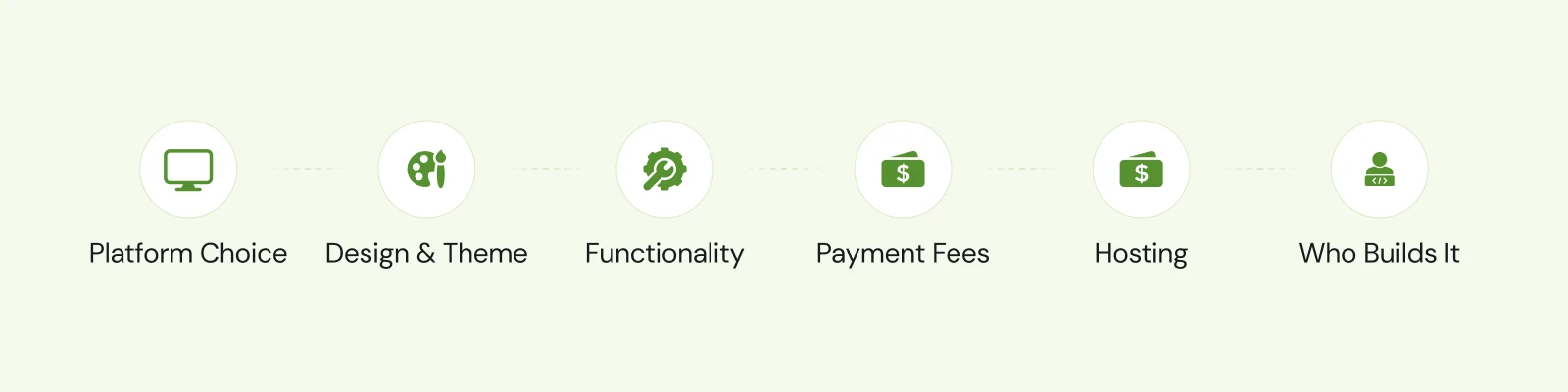
- Platform choice: A subscription platform like Shopify or Wix bundles hosting and security into one fee. A self-hosted platform like WooCommerce separates them, which can cost less but takes more setup work.
- Design and theme: A free or low-cost theme keeps costs down. A fully custom design is the single biggest line item on most custom builds.
- Functionality: Every extra feature, subscriptions, multi-currency, advanced filtering, usually means another paid app or plugin.
- Payment gateway and transaction fees: Some platforms charge a percentage on every sale unless you use their own payment processor.
- Hosting: Subscription platforms include this. Self-hosted platforms like WooCommerce require you to choose and pay for it separately. And, as you'll see below, "hosting" isn't one price, it's several very different tiers.
- Who builds it: DIY, freelancer, and agency builds land in very different price ranges.
eCommerce Website Cost by Category: Real Providers and Prices
This is the part most cost guides skip: which specific companies actually offer what, and at what price.
Here is the real breakdown, category by category, whether you are using a drag-and-drop builder, a self-hosted CMS, or a fully custom web app.
Domain Names
A standard .com domain typically costs $10 to $20 per year. The exact price depends heavily on where you register it and whether you are looking at the introductory rate or the renewal rate.
- Cloudflare: The most transparent option available. They sell domains at wholesale cost with zero markup, meaning a standard .com stays around $8-15 per year. They also include top-tier free security features and WHOIS privacy.
- Namecheap: Consistently affordable, with .com domains starting around $8.88 to $15.98 per year at introductory pricing. They include free WHOIS privacy protection on most domains, a feature some competitors charge extra for. Their dashboard is also incredibly beginner-friendly.
Alongside these, GoDaddy is another big player in this space. It is highly convenient if you want all your business services bundled in one place.
However, their renewal pricing tends to jump more sharply after the first year. So, we recommend you check the renewal rate before you commit.
Porkbun, a rising favorite among developers, offers fantastic transparent pricing (around $10.37 per year for a .com), including free WHOIS privacy and SSL certificates.
Web Hosting (By Type)
If you use a SaaS platform like Shopify or Wix, your hosting is already bundled into your monthly subscription. However, if you are using WooCommerce, Magento, or building a custom app with a framework like Laravel, you must purchase your own server space.
Hosting is not one price, it is several genuinely different tiers. Picking the wrong one is one of the most common eCommerce budgeting mistakes.
| Hosting Tier | Typical Price | Example Providers | Best For |
|---|---|---|---|
| Shared Hosting | $2 to $25/month | Hostinger, Bluehost, SiteGround | Very small stores just starting out |
| Managed CMS Hosting | $4 to $35/month | Hostinger, Kinsta, WP Engine | Stores wanting built-in optimization for WordPress or Magento |
| VPS & Cloud Hosting | $6 to $150/month | Cloudways, DigitalOcean, AWS | Growing stores and custom web apps needing dedicated resources and flexible scaling |
| Enterprise / Custom | $100 to $1,000+/month | AWS, Google Cloud, Liquid Web | Established stores prioritizing speed, high traffic spikes, and custom architectures |
A few specifics worth knowing:
- Hostinger: Offers affordable managed plans built to handle up to 200,000 monthly visits, making it one of the most budget-friendly ways to get platform-specific optimization.
- Kinsta & WP Engine: Consistently recommended for WooCommerce stores specifically because of how they handle caching around dynamic pages like carts and checkouts, which generic caching setups can get wrong.
- DigitalOcean & AWS: The gold standard for custom-built stores (like Laravel or Node.js apps). Developers use these cloud providers to build highly scalable environments from the ground up.
SEO and Marketing Tools
The tools you need depend entirely on the platform you choose to build with.
- For WordPress/WooCommerce: Rank Math includes WooCommerce-specific SEO features in its free core plugin, with Pro versions starting around $59 per year. Yoast SEO is a long-standing alternative. To connect Google Analytics to your dashboard, MonsterInsights ranges from $99 to $399 per year.
- For Shopify: Apps like Booster SEO or Plug in SEO run about $30 to $40 per month to automate technical SEO audits, fix broken links, and optimize product images.
- For Wix: The native Wix SEO Dashboard is incredibly robust and completely free with your plan. It covers most basic and intermediate indexing needs without requiring third-party apps.
- Platform Agnostic (Email & Popups): Tools like OptinMonster handle popups and lead-capture for $9 to $49 per month. For email marketing, Klaviyo is the eCommerce industry standard, integrating seamlessly with Shopify, WooCommerce, and custom builds, scaling its price based on your total subscriber count.
Security and Backup
- For SaaS (Shopify, Wix, BigCommerce): While the platform secures your server against hackers, they do not back up your actual store data. If you accidentally delete a product catalog or ruin your theme, it is gone. Apps like Rewind Backups (starting around $9 to $39/month) are vital for restoring SaaS storefronts.
- For WordPress/WooCommerce: Wordfence provides a genuinely comprehensive free tier, while Premium runs $119 to $149 per year for a real-time firewall and malware rules. For backups, UpdraftPlus provides free automated backups, with Premium starting around $70 per year.
- For Custom Builds: Cloudflare is the industry standard for DDoS protection and Web Application Firewalls (WAF) to protect custom Laravel or React front-ends. For backups, server-level snapshots (like DigitalOcean Snapshots) typically cost around 20% of your total monthly server cost.
Payment Processing Fees
Every platform needs a payment processor, and the fees are easy to underestimate since they scale directly with your revenue.
| Processor | Standard Fee | Notes |
|---|---|---|
| Stripe | 2.9% + $0.30 per transaction | Industry-standard rate, widely supported |
| PayPal | 3.49% + a fixed fee based on location | Slightly higher than Stripe on most transactions |
| Authorize.net | 2.9% + $0.30, plus a $25/month gateway fee | The added monthly fee makes it costlier at low volume |
On a $100,000 year in sales, a 2.9% processing rate alone works out to roughly $2,900. This cost might be easy to overlook when comparing platform subscription prices, but that adds up faster than almost any other line item on this list as your store grows.
eCommerce Website Cost by Platform
Here's what each major platform actually costs in 2026, based on current pricing.
Shopify Cost Breakdown
Shopify has five main plans in 2026:
- Agentic – $0/month: New for 2026. No storefront of your own; instead, your product catalog sells through AI shopping assistants like ChatGPT, Gemini, and Perplexity, and you pay only per completed sale.
- Basic – $39/month: The entry point for a full online store.
- Grow – $105/month (around $79/month billed annually): Adds stronger reporting and lower transaction fees.
- Advanced – $399/month (around $299/month annually): Built for higher-volume stores.
- Plus – from $2,300/month (3-year term; $2,500/month on a 1-year term): Enterprise-level.
Add payment processing (2.7%–2.9% + 30 cents per transaction if you don't use Shopify Payments), a premium theme (often a few hundred dollars, one-time), and apps. This is commonly $40 to several hundred dollars a month for a real, functioning store. A realistic all-in monthly cost for a small-to-mid Shopify store in 2026 is closer to $60–$300+.
WooCommerce Cost Breakdown
WooCommerce itself is free, but a live store needs hosting, a domain, and usually a premium theme and a few paid plugins:
- Domain name: $12–$15/year (Namecheap or similar)
- Hosting: $4–$30/month for shared or dedicated WooCommerce hosting (see the hosting table above)
- Premium theme: $59–$99/year
- Essential plugins (SEO, security, backups): commonly $200–$450/year combined
Add it up, and a real, functioning small WooCommerce store typically costs $400 to $1,000 in year one, then $300 to $1,200 a year after that. WooCommerce itself never takes a percentage of your sales; you only pay your payment processor's rate.
A real example worth noting: Smile Brilliant, an oral care brand managing over 2,000 products and around 50,000 orders a year on WooCommerce, reports an annual setup cost of roughly $4,000 to $5,000. That includes managed hosting, a premium theme, essential plugins, and email/SMS marketing software. According to the company, that investment supported a 47% increase in automation-driven revenue and a 36% repeat purchase rate.
Where DiviMerc Could Fit In
Here's a category most cost breakdowns miss entirely: the product page itself. A default WooCommerce product page doesn't include variation swatches, a real image gallery, urgency signals, or trust badges. Each of those normally means shopping for and paying for a separate plugin, often from a different developer, with its own update cycle and its own subscription.
DiviMerc bundles that entire layer. Variation swatches, advanced product galleries, stock progress bars, sales counts, and trust badges – all into native Divi 5 modules, in one plugin instead of four or five
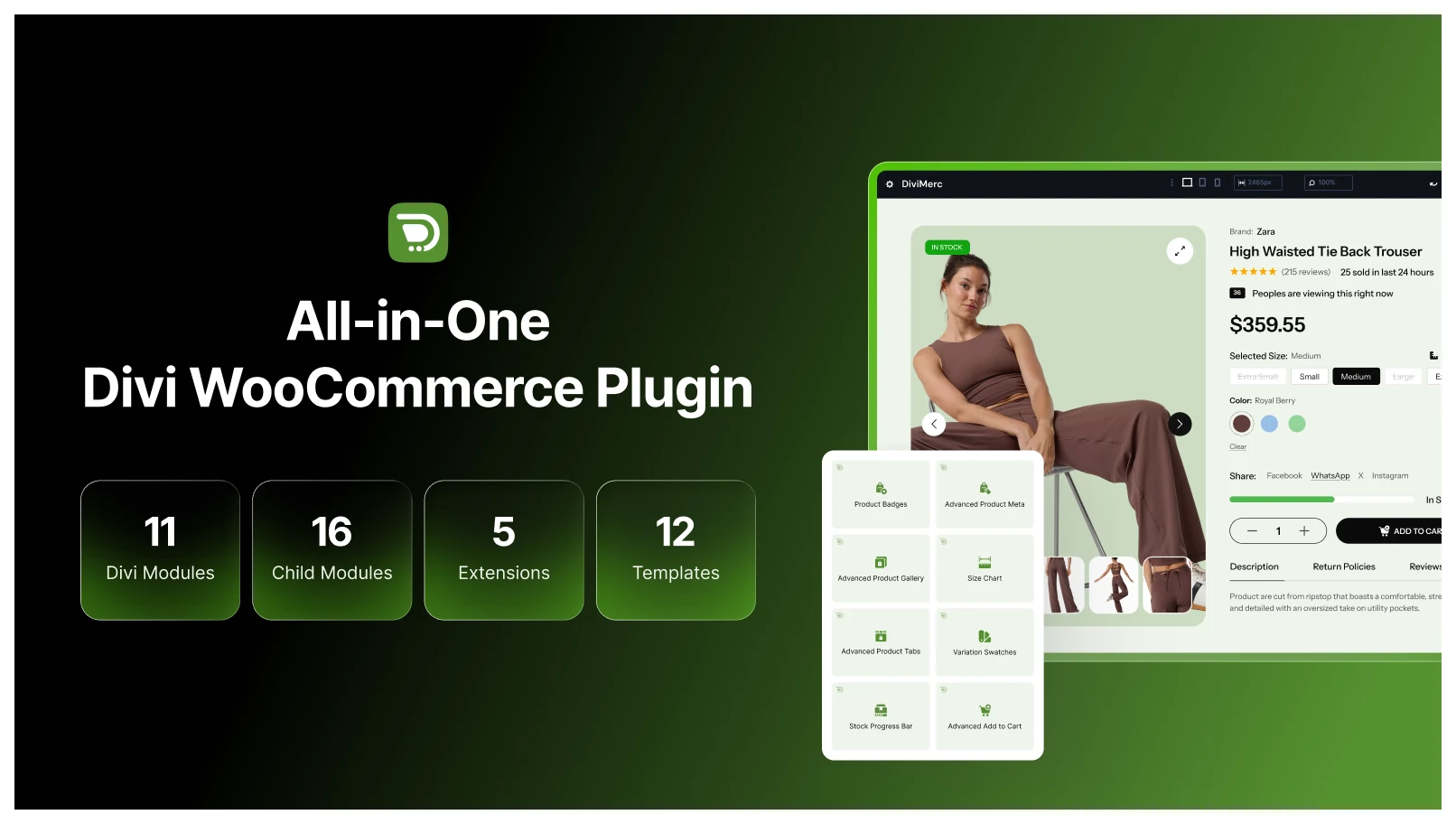
For a store already budgeting $200–$450/year on plugins, as discussed above, consolidating several single-purpose product-page plugins into one toolkit is a real, calculable way to reduce that line item, not just a convenience claim. Check the current pricing plans for exact rates.
Wix Cost Breakdown
Wix's plans in 2026:
- Light – $17/month: No eCommerce features.
- Core – $29/month: Entry point for selling, up to 50,000 products.
- Business – $39/month: Adds advanced eCommerce and shipping features.
- Business Elite – $159/month: Full feature access.
- Enterprise – from $500/month: Custom pricing.
Transaction fees (around 2.9% + 30 cents) and app costs (roughly $3–$20/month per app) apply on top. A hired build on top of a Wix plan typically runs $2,000–$10,000/year for a small business, or $3,000–$20,000+/year agency-managed.
Custom eCommerce Website Cost
A fully custom-built eCommerce website is the most expensive path, and the one with the widest range:
- Freelancer-built: $500–$5,000 for a straightforward custom store.
- Agency-built (small business): $5,000–$25,000+.
- Agency-built (enterprise): $10,000–$35,000+ upfront, with maintenance around $15,000/year.
- Full custom development from scratch: $30,000–$100,000+, typically reserved for large catalogs or complex integrations.
eCommerce Website Development Cost: Agency vs. Freelancer vs. DIY
DIY (you build it yourself): The cheapest option, usually just your platform's subscription plus a theme. Realistic for a straightforward store, especially on a platform like Shopify, Wix, or WooCommerce with Divi's visual builder handling the design work. If you want to take the DIY route, follow our step-by-step guide on how to build an eCommerce website to set up and design your store from scratch.
Freelancer: A good middle ground, $500–$5,000 typically, without an agency's overhead. Quality varies more than with an agency, so vetting matters.
Agency: The most expensive but most hands-off option, typically $5,000–$30,000+, with ongoing maintenance retainers often running $500–$1,500+ a month afterward.
eCommerce Website Cost Breakdown by Business Size
| Business Stage | Typical First-Year Cost | Common Approach |
|---|---|---|
| Solo/small store (10–50 products) | $400–$2,000 | DIY or light freelancer engagement on a base platform plan |
| Growing brand (100–500 products) | $2,000–$15,000 | Mid-tier platform plan plus freelancer or small-agency design work |
| Established business (1,000+ products, subscriptions, international) | $15,000–$50,000 | Agency-built with dedicated developer support |
| High-traffic/enterprise operation | $50,000–$100,000+ | Shopify Plus or a fully custom WooCommerce/headless build |
Custom eCommerce Website Cost vs. Ready-Made Platforms
A ready-made platform (Shopify, Wix, or a themed WooCommerce build) gets you live faster, with less risk, for a predictable recurring cost. Most small and mid-sized stores genuinely don't need more than this.
A custom build costs significantly more upfront but removes template limitations entirely – useful for businesses with unusual checkout logic or deep ERP integration needs. For most businesses, that level of customization isn't necessary.
A practical middle ground on WordPress: start with a ready-made theme and a toolkit like DiviMerc for the product-page and merchandising layer, and add custom development only for the specific pieces that genuinely need it.
Hidden and Ongoing eCommerce Website Costs
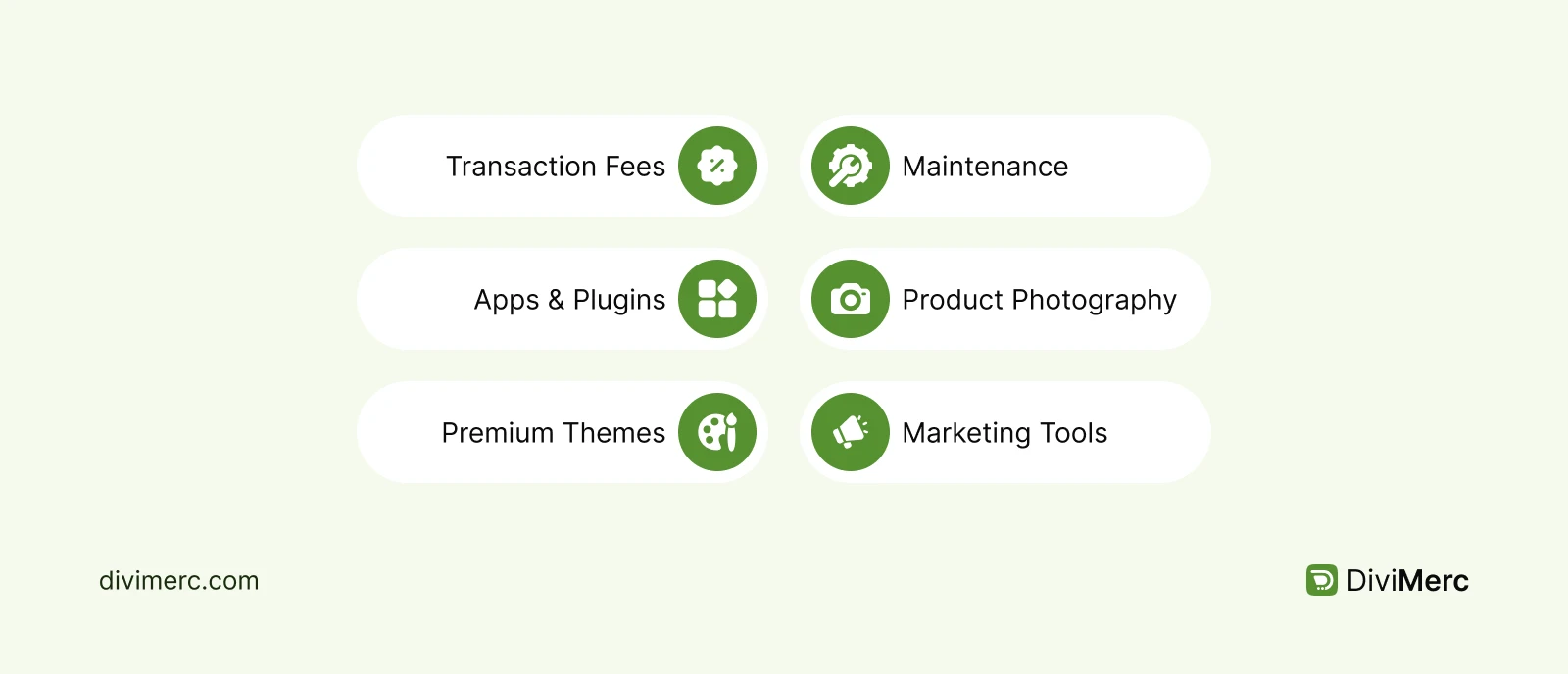
- Transaction fees. Shopify and Wix charge a percentage per sale unless you use their own payment processor. WooCommerce charges nothing itself, but your processor still takes its own cut.
- Apps and plugins. The single biggest source of "surprise" cost on every platform – commonly $50–$400+ a month for a handful of genuinely useful tools.
- Premium themes. One-time or annual, typically $50–$300.
- Ongoing maintenance. Security updates and general upkeep, often skipped in DIY budgets and paid for later in downtime instead.
- Content and product photography. Rarely included in any platform quote.
- Marketing tools. Email, SMS, and analytics subscriptions, commonly $20–$200+ a month.
How to Reduce Your eCommerce Website Cost
- Start on a ready-made platform rather than a full custom build. Migrate later once you know what your store actually needs.
- Use the platform's own payment processor where possible, to avoid extra third-party gateway fees.
- Audit your apps and plugins regularly. It's common to keep paying for tools you stopped using months ago.
- Use a toolkit that bundles features instead of stacking single-purpose plugins. Each separate plugin is its own subscription and its own update cycle.
- Negotiate annual billing. Nearly every platform and app offers a discount, commonly 20–25%, for paying yearly.
Is an eCommerce Website Worth the Investment?
For most businesses, yes, but not immediately. Global retail eCommerce sales are forecast to reach $6.88 trillion in 2026, according to EMARKETER's forecast, up 7.2% from 2025 and now accounting for over 21% of all retail spending worldwide. The market itself isn't the risk; the timeline is.
Most sources converge on 6 to 24 months as the realistic timeline for a new store to become profitable, not just to make its first sale. A few well-known brands took considerably longer, Allbirds and Bonobos both operated at a loss for years while building brand recognition.
On margins: a good gross profit margin for eCommerce typically falls between 50% and 70%, though the actual industry average is closer to 41.54%, based on data compiled by NYU Stern School of Business.
The honest framing: an eCommerce website is a real investment with a real payback period, not a purchase that pays for itself in month one.
Frequently Asked Questions about eCommerce Website Cost
How much does an eCommerce website cost?
Most small to mid-sized eCommerce websites cost between $500 and $10,000 to launch, with ongoing costs of $50 to $500 a month. Custom, enterprise-level builds can run well beyond that.
What's the cheapest WooCommerce hosting available?
Budget shared hosting from providers like Hostinger or Bluehost starts around $2–$5/month, and Hostinger also offers a dedicated WooCommerce hosting plan from around $3.99/month, which is typically a better fit than generic shared hosting for a store specifically.
What are the cheapest options for building an eCommerce website?
Shopify's Basic plan ($39/month) or Wix's Core plan ($29/month) are the cheapest ready-made platforms with real store functionality. On WooCommerce, a bare-minimum setup can start around $100/year.
Can I start an eCommerce website for free?
Not entirely. Every real option requires at least a domain and hosting or a paid platform plan. Shopify's Agentic plan is $0/month but doesn't include your own storefront.
Can I build an eCommerce website myself?
Yes, especially on Shopify, Wix, or WordPress with a visual builder like Divi. It takes more of your own time, but it's realistic for a straightforward store.
What factors influence the overall cost of an eCommerce website?
Platform choice, design and theme customization, feature requirements, payment processing fees, hosting tier, and who builds the site.
What are the ongoing monthly or recurring costs for an eCommerce website?
Typically hosting or platform fees, payment processing fees, app or plugin subscriptions, and marketing tool costs – usually $50 to $500 a month for small to mid-sized stores.
What are the hidden costs associated with an eCommerce website?
Transaction fees, ongoing app/plugin subscriptions, premium theme costs, product photography, and maintenance time that DIY store owners often underestimate.
Is an eCommerce website a worthwhile investment?
For most businesses, yes, though it typically takes 6 to 24 months to become profitable rather than immediately.
How can I reduce the cost of building and maintaining an eCommerce website?
Start on a ready-made platform, use the platform's own payment processor where possible, regularly audit and cancel unused apps, choose a bundled toolkit over stacking single-purpose plugins, and pay annually where discounted.
What is the cost difference between DIY platforms and hiring a professional?
DIY typically costs just the platform subscription and theme, often under $1,000 in year one. A freelancer typically runs $500–$5,000. A full agency build typically runs $5,000–$30,000+.
How long does it take for an eCommerce store to become profitable?
Most sources put the realistic range at 6 to 24 months, depending on niche, marketing effort, and market competitiveness.
Are there any free eCommerce platforms?
WooCommerce's core plugin is free, though you'll still need hosting and a domain. Wix and Shopify both offer free tiers, but neither includes real eCommerce functionality without upgrading.
Can I get an eCommerce website for under $1,000?
Yes. A WooCommerce store with basic or dedicated WooCommerce hosting, a free or low-cost theme, and essential plugins typically lands in the $400–$1,000 range for year one.
Do I need to hire a developer for website maintenance?
Not necessarily. Routine updates can often be handled without a developer, especially on managed hosting that automates this. Custom-built or highly customized stores are more likely to need ongoing developer support.
Final Thoughts
There's no single honest answer to "how much does an eCommerce website cost". But there is an honest range. And now you have it, with the actual providers behind those numbers: roughly $400 to $2,000 for a lean, DIY-friendly small store on hosts like Hostinger or Namecheap for the basics, climbing into the tens of thousands for agency-built or enterprise operations on premium hosts like Kinsta or WP Engine.
The platform you choose changes the shape of that cost more than almost anything else. Shopify and Wix trade a higher subscription fee for less setup work. WooCommerce trades more setup responsibility for no required transaction fees and full control over your stack. And, if you're building on WordPress with Divi, DiviMerc exists specifically to reduce how many separate paid plugins that setup responsibility actually requires, by handling product-page merchandising, urgency, and trust signals in one native toolkit instead of four or five.
Whichever path you choose, budget for the real number (providers, hosting tier, and hidden fees included), not just the plan price on the homepage.


0 Comments