

WooCommerce runs a huge part of the internet's online stores. But if you search "WooCommerce statistics," you'll find dozens of articles repeating the same few numbers – some outdated, some copied from each other and a few that we couldn't trace back to any real source at all.
So we did something different. We went to the primary sources ourselves: W3Techs, WordPress.org, BuiltWith, Store Leads, Metorik and more for more than 65 million real WooCommerce orders. Where a popular stat didn't hold up, we say so instead of repeating it anyway.
Below you'll find over 110 WooCommerce statistics for 2026, covering market share, sales, plugins, themes, security and a few things almost nobody else is covering yet – like how AI shopping tools are already changing WooCommerce stores today.
Let's start with the short version.
WooCommerce Statistics 2026 at a Glance
| Category | Key Number | What It Means |
|---|---|---|
| Market share | 8.1% of all websites, 48.1% of identified and known eCommerce systems (W3Techs, Aug 2026) | Still the largest single eCommerce platform by share |
| Live stores | 4.3M+ live stores (Store Leads) vs. 7M+ plugin installs (WordPress.org) | The right number depends on what you're counting |
| Average order value | $105 (Metorik, 2025 data) | Desktop orders ($167) far outspend mobile ($71) |
| Refund rate | 1.4% | Down from 2.4% in 2023 |
| HPOS adoption | ~78% of existing stores | Can make order processing up to 5x faster |
| AI/agentic traffic | +393% year over year (Q1 2026) | AI-referred shoppers spend 53% more per visit |
| Plugins per store | 58 on average | Stable since 2023 – store owners aren't adding much |
| Top themes | Elementor (9.3%), Flatsome (7.4%) | Divi powers 2.3% of WooCommerce stores |
| WooCommerce vs. Shopify | WooCommerce leads on store count; Shopify leads on total sales volume | Different platforms win different kinds of stores |
A Quick Note on Our Sources
Before we get into the numbers, one honest note: WooCommerce statistics vary a lot depending on who's counting and how.
Some articles report WooCommerce at 20% market share. Others say 33%, 39% or even 49%. None of them are necessarily wrong. They're just measuring different things.
W3Techs measures the top 10 million websites by traffic. Store Leads crawls over 13 million eCommerce stores of every size. BuiltWith detects any site with WooCommerce code, active or not. Every number in this article names its source and what that source actually measured, so you're not comparing apples to oranges without knowing it.
We also want to flag one specific thing: you might see a "$30–35 billion in annual WooCommerce GMV" figure in a few statistics articles online. We tried to trace it back to an original source and couldn't confirm one.
So, instead of repeating it as fact, we're telling you that upfront and sticking to numbers we can actually verify – like Matt Mullenweg's $20 billion figure from 2020, said in a keynote speech in State of the Word 2020.
General WooCommerce Statistics
1. WooCommerce Launched in 2011
WooCommerce started as a free WordPress plugin in September 2011, built by the team at WooThemes. (WooCommerce)
2. It Began as a Fork of an Existing Plugin
WooCommerce was originally based on Jigoshop, an earlier WordPress shopping cart plugin. (WooCommerce history)
3. Automattic Acquired WooCommerce in 2015
WordPress.com's parent company, Automattic, acquired WooCommerce in a deal worth around $30 million. (WooCommerce)
4. WooCommerce Has More Than 350 Core Contributors
Hundreds of developers around the world help build and maintain WooCommerce's core code. (WooCommerce Newsroom)
5. Over 90,000 Professionals Work in the WooCommerce Ecosystem
Developers, designers, and agencies who specialize in WooCommerce make up a large support industry around the platform. (WooCommerce Newsroom)
6. WooCommerce Runs on 8.1% of All Websites
As of August 2026, WooCommerce powers 8.1% of every website W3Techs tracks – not just eCommerce sites, but every site on the internet in their sample. (W3Techs)
7. WooCommerce Makes Up 11.7% of Known Content Management Systems
When you only count websites that use some kind of content management system, WooCommerce's share rises to 11.7%. (W3Techs)
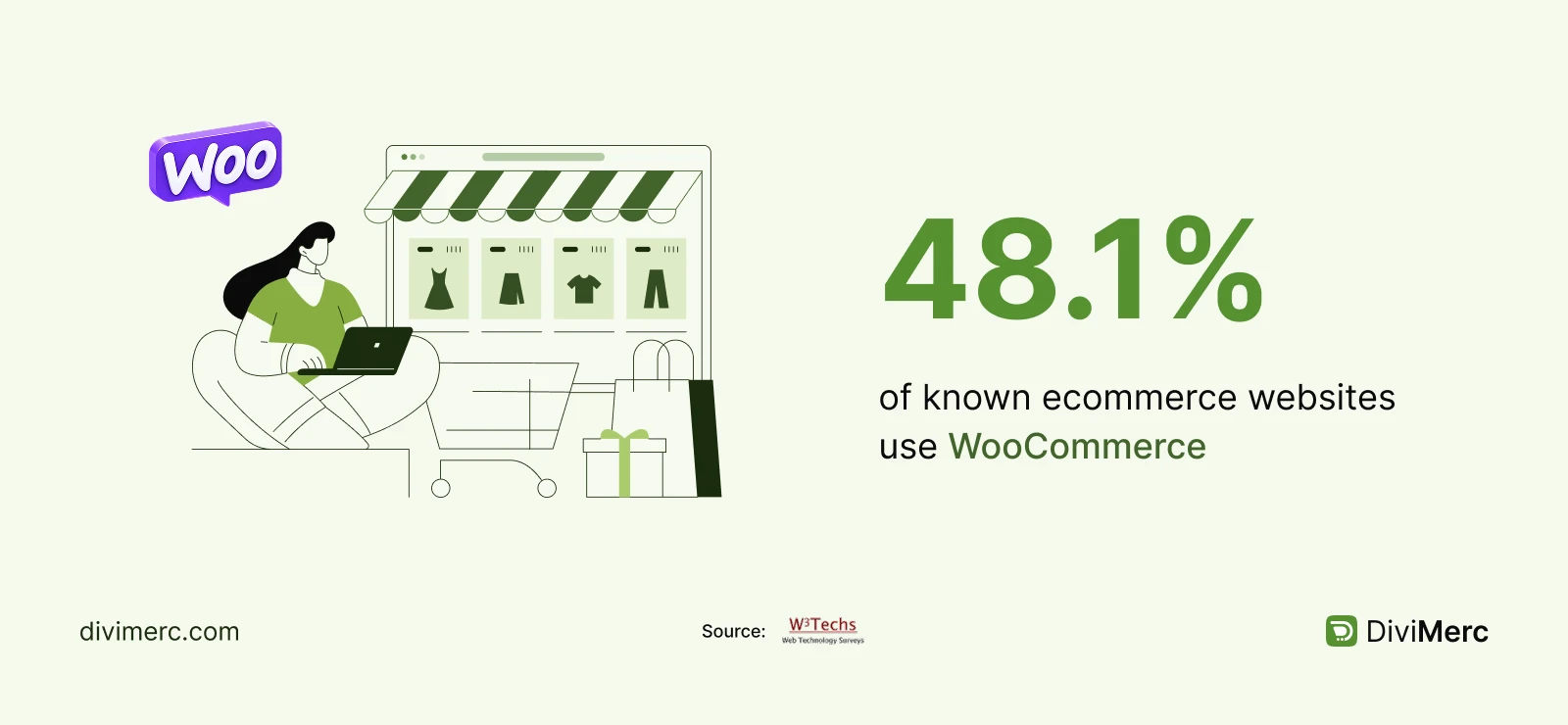
8. WooCommerce Holds 48.1% of Known eCommerce CMS Systems
Nearly half of all eCommerce websites, as identified by W3Techs for CMS, run WooCommerce. (W3Techs)
9. Around One in Five WordPress Sites Uses WooCommerce
Roughly 19–20% of WordPress websites have WooCommerce installed and active. (W3Techs)
10. BuiltWith Detects WooCommerce on More Than 6.3 Million Live Sites
BuiltWith's broader detection method, which looks for WooCommerce code rather than just active installs, counts over 6.3 million live websites. (BuiltWith)
11. WordPress.org Shows Over 7 Million Active Installations
WordPress.org's own plugin directory reports more than 7 million sites with WooCommerce actively installed. (WordPress.org)
12. Store Leads Counts 4+ Million Live Stores
Store Leads, which specifically tracks live, functioning eCommerce stores rather than plugin installs, counts roughly 4+ million active WooCommerce stores. (Store Leads)
13. WooCommerce Has Been Detected on Over 19 Million Sites Total
Counting every website that has ever run WooCommerce, including ones that switched away or went offline, pushes the total more than 19 million. (BuiltWith)
WooCommerce Usage Statistics and Growth Trends
14. Store Counts Can Differ by Millions Depending on the Source
This is worth repeating: "how many WooCommerce stores exist" doesn't have one single correct answer. It depends on whether you're counting live stores, plugin installs or all detected code. Always check what a number is actually measuring before comparing it to another one.
15. WooCommerce's Website Share Slipped Slightly in the Past Year
WooCommerce's overall share of all websites fell from around 9% in mid-2025 to around 8.1% in August 2026. (W3Techs)
16. Live Store Counts Are About 15% Below Their Late-2024 Peak
Store Leads' data shows WooCommerce's live-store count peaked around late 2024 and has eased back slightly since. (Store Leads)
17. 42% of Stores Run the Newest WooCommerce Version
As of March 2026, 42% of WooCommerce stores in Metorik's sample were running the latest version, 10.5. (Metorik)
18. 83% of Stores Run Some Version in the 10.x Line
The large majority of WooCommerce stores have moved onto the current major version series. (Metorik)
19. 71% of Stores Run the Newest WordPress Core Version
WordPress 6.9 was already running on 71% of sampled WooCommerce stores as of March 2026. (Metorik)
20. WordPress Itself Powers 40.2% of All Websites
WooCommerce's home platform, WordPress, remains the single biggest content management system on the web by a wide margin. (W3Techs, September 2026)
WooCommerce Sales Statistics
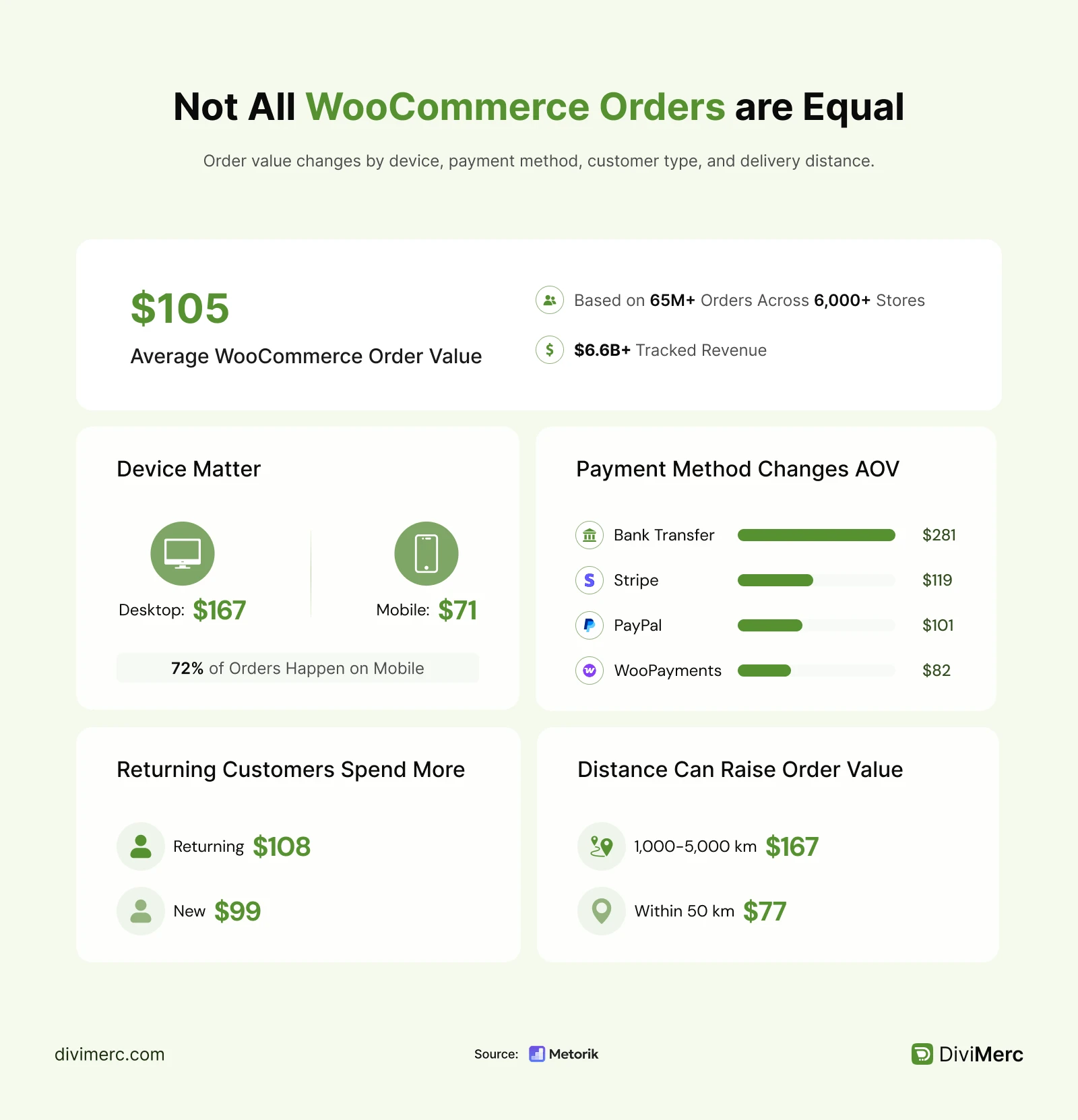
21. The Average WooCommerce Order Is Worth $105
This figure comes from Metorik's analysis of more than 65 million real orders placed across 6,000+ WooCommerce stores in 2025. (Metorik)
22. That Data Represents More Than $6.6 Billion in Tracked Revenue
Metorik's 2026 report is built on a sample worth over $6.6 billion in actual order revenue, not estimates. (Metorik)
23. Desktop Orders Average $167 – More Than Double Mobile
Shoppers on desktop spend $167 per order on average, compared with $71 on mobile. (Metorik)
24. 72% of Orders Happen on Mobile, Despite Lower Spending
Even though mobile shoppers spend less per order, they place the clear majority of WooCommerce orders. (Metorik)
25. Bank Transfer Orders Average $281 – The Highest of Any Payment Method
Customers who pay by bank transfer spend nearly three times the overall average per order. (Metorik)
26. Stripe Orders Average $119
Stripe, the most commonly used WooCommerce payment gateway, sees orders slightly above the platform-wide average. (Metorik)
27. PayPal Orders Average $101
PayPal orders come in just under the platform-wide average. (Metorik)
28. WooPayments Orders Average $82
WooCommerce's own built-in payment option, WooPayments, sees the lowest average order value among major gateways. (Metorik)
29. Returning Customers Spend $108 vs. $99 for New Customers
At a typical store, loyal customers spend more per order than first-time buyers – though this flips when you weight by total order volume, since a few very large stores skew the average. (Metorik)
30. Distant Customers Spend Almost Double
Customers ordering from 1,000–5,000 km away spend about $167 per order, roughly twice as much as customers within 50 km, who average $77. (Metorik)
31. The 50–250 km Delivery Zone Drives the Most Orders
Nearly 3 in 10 orders (29%) come from customers living 50–250 km from the store. (Metorik)
32. The Average Refund Rate Fell to 1.4%
WooCommerce's average refund rate across all industries dropped to 1.4% of orders in 2025, down from 2.4% in 2023. (Metorik)
33. Big Stores Refund Less Often, But Pay More Per Refund
Larger stores have a lower refund rate overall, but each refund costs them $252 on average, versus $122 for small stores. (Metorik)
34. WooCommerce Hit $20 Billion in Sales Back in 2020
WordPress co-founder Matt Mullenweg publicly stated that WooCommerce-powered stores processed $20 billion in sales in 2020, describing it as 100% year-over-year growth at the time. This remains the last specific total-sales figure Automattic has shared publicly. (Matt Mullenweg, State of the Word)
WooCommerce vs. Shopify Statistics
35. WooCommerce Leads on Live Store Count
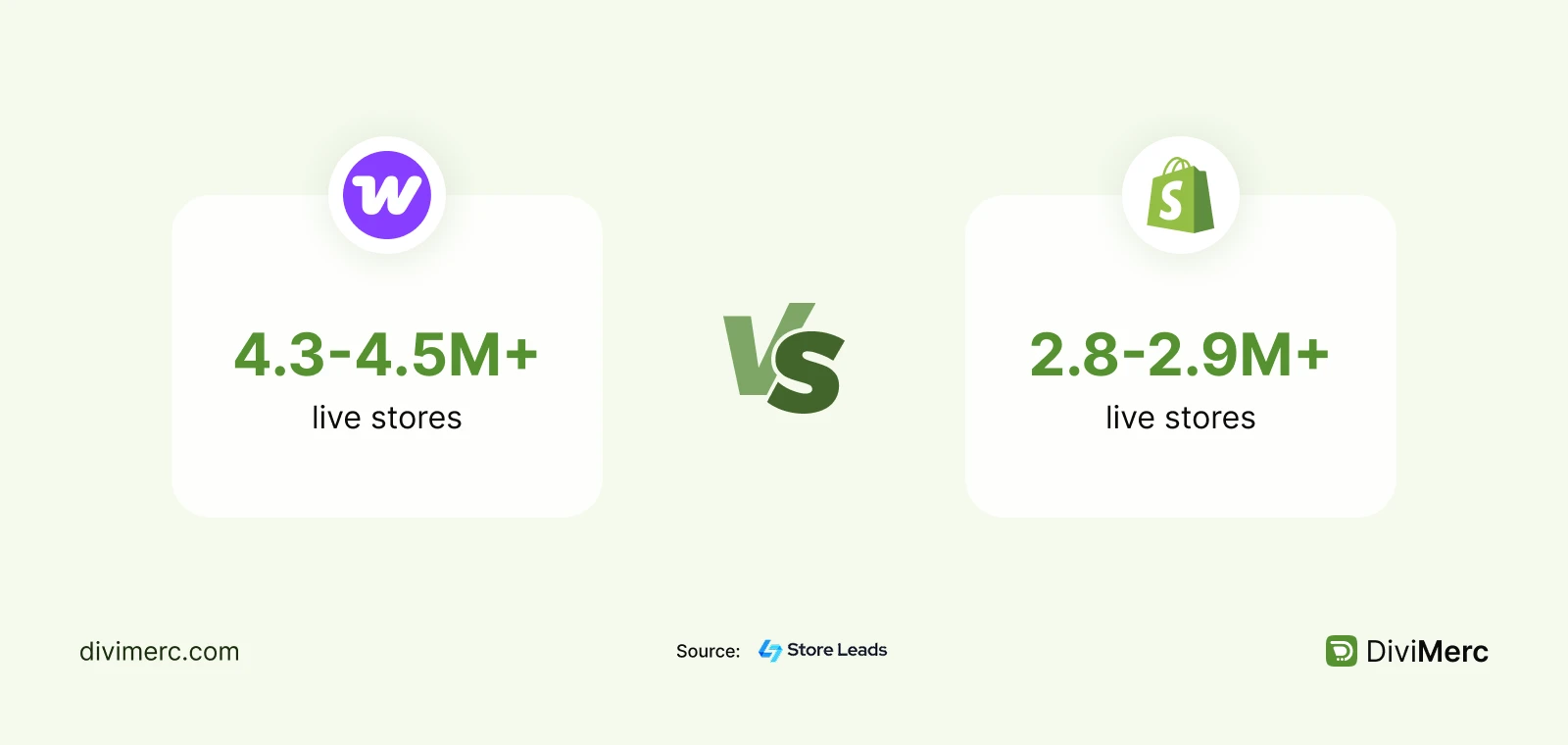
Store Leads tracks roughly 4.3–4.5 million live WooCommerce stores, compared with about 2.8–2.9 million live Shopify stores. (Store Leads)
36. Shopify Leads on Total Sales Volume
Shopify facilitated $378.4 billion in GMV in 2025, up 29% from $292.3 billion in 2024. Shopify defines GMV as the total dollar value of orders facilitated through its platform, net of refunds and including shipping, handling, duties, and VAT. (eCommercetrix/Shopify reporting)
37. Shopify Has a Stronger Presence Among High-Traffic Sites
BuiltWith data suggests Shopify has a larger presence than WooCommerce among the web’s top one million sites by traffic. This may reflect stronger adoption by larger consumer brands, but it does not prove higher revenue or universal preference among high-revenue merchants. (BuiltWith)
WooCommerce Performance Statistics
38. 42.9% Get a "Good" Mobile Loading Score
42.9% of stores score well on Largest Contentful Paint (LCP), the metric for how fast a page's main content appears. (HTTP Archive)
39. WooCommerce Stores Achieve a Median SEO Score of 91
While mobile load times and overall performance tend to lag, most WooCommerce sites are fundamentally well-optimized for search engines out of the box. (HTTP Archive)
40. 63.6% Score Well on Visual Stability
Visual stability measures whether a page's layout jumps around while it loads, and 63.6% of stores handle this well. (HTTP Archive)
41. The Average WooCommerce Page Weighs About 3 MB
That's the total size of a typical WooCommerce page, including all images, scripts, and styling. (HTTP Archive)
42. Images Account for About 1.5 MB of That Weight
Roughly a third of an average page's total size comes from images alone. (HTTP Archive)
43. WooCommerce Pages Load About 777 KB of JavaScript
JavaScript code makes up a substantial share of total page weight on most WooCommerce sites. (HTTP Archive)
44. PHP 8.2 Is the Most Common PHP Version
33% of WooCommerce stores run PHP 8.2, the most widely used version in Metorik's 2026 sample. (Metorik)
45. About 12% of Stores Still Run PHP 7.4
PHP 7.4 stopped receiving official security updates years ago. Roughly 1 in 8 WooCommerce stores is still running it – one of the easiest, highest-impact fixes any store owner can make. (Metorik)
46. WooCommerce 11.0 Shipped With 28 Performance Improvements
A single WooCommerce release included 28 separate, documented performance upgrades. (WooCommerce changelog)
47. Product Caching Can Improve Speed by Up to 12%
Turning on product-level caching is one of the simpler ways to meaningfully speed up a WooCommerce store. (Woo Developer Blog)
WooCommerce High-Performance Order Storage (HPOS) Statistics
This is one of the newest, least-covered parts of WooCommerce's data – and it's genuinely changing how stores handle orders behind the scenes.
48. HPOS Stores Orders in Their Own Dedicated Tables
Instead of storing orders in WordPress's general-purpose database tables (built for blog posts, not eCommerce), HPOS uses tables designed specifically for order data. (WooCommerce developer docs)
49. HPOS Can Make Order Creation Up to 5x Faster
Stores with high order volume see the biggest speed gains from switching to HPOS. (WooCommerce)
50. Backend Order Searches Can Run Up to 40x Faster
Filtering and searching through orders in the WooCommerce admin becomes dramatically faster once HPOS is active. (WooCommerce)
51. HPOS Became the Default for New Stores in October 2023
WooCommerce 8.2 turned HPOS on by default for any brand-new store, while existing stores had to opt in manually. (WooCommerce Blog)
52. HPOS Caching Graduated From Experimental to Standard in December 2025
WooCommerce 10.4 moved HPOS's caching layer out of experimental status, making it a fully supported, recommended feature rather than a beta toggle. (Woo Developer Blog)
WooCommerce and AI / Agentic Commerce Statistics
This entire category barely existed a year ago. In 2026, it's one of the fastest-moving parts of WooCommerce's story. And it directly affects how shoppers are finding, and buying from, WooCommerce stores right now.
53. WooCommerce Launched an AI Assistant Protocol in October 2025
WooCommerce 10.3 introduced a Model Context Protocol (MCP) beta, letting AI assistants like Claude and ChatGPT search a store's products, check inventory, and manage orders directly. (WooCommerce)
54. WooCommerce Is a Launch Partner for Stripe's Agentic Commerce Suite
Announced in December 2025, this partnership lays groundwork for AI-powered checkout flows that can happen partly off a store's own site. (Stripe)
55. AI-Driven Retail Traffic Grew 393% Year Over Year
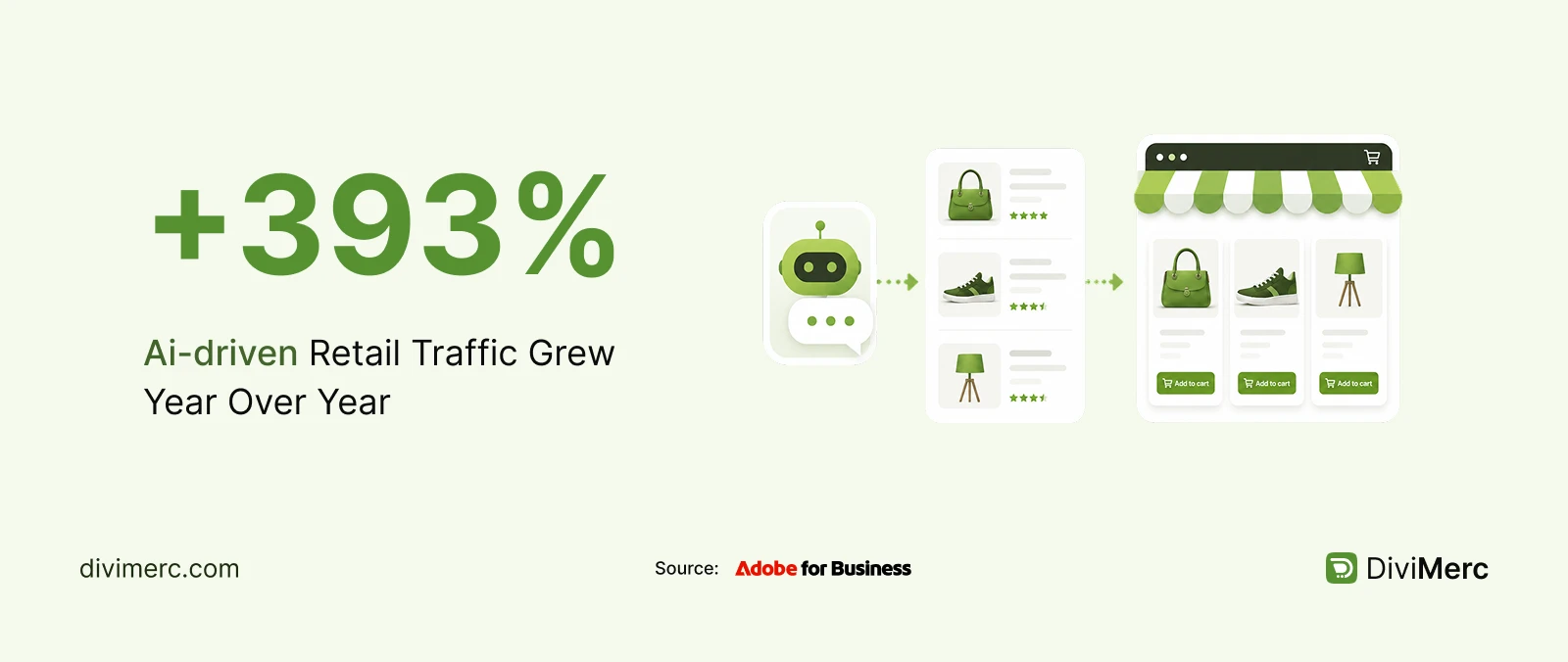
AI-referred traffic to US retail websites grew 393% year over year in the first quarter of 2026. (Adobe Analytics)
56. That Growth Spiked Even Higher in a Single Month
March 2026 alone saw AI referral traffic jump 269% year over year – one of the fastest-growing traffic sources retailers have ever tracked. (Adobe Analytics)
57. AI-Referred Shoppers Convert 42% Better
In March 2026, shoppers arriving at U.S. retail sites from AI sources converted 42% better than non-AI traffic. AI-referred visitors also spent 48% longer on sites, viewed 13% more pages per visit, and had a 12% higher engagement rate. (Adobe Analytics)
58. A Third of US Shoppers Would Let AI Buy for Them
80% of U.S. shoppers say they are open to AI completing final transactions, up from 34% in February 2025. The survey was conducted by Cint in late January 2026 among 1,072 U.S. consumers, with a stated ±3 percentage-point margin of error. (Omnisend survey)
59. AI Could Influence Trillions in Retail Revenue by 2030
McKinsey estimates AI-driven commerce could influence up to $1 trillion in US retail revenue, and $3–5 trillion worldwide, by the end of the decade. (McKinsey)
60. AI Agents Drove an Estimated $262 Billion in Holiday Sales
During the 2025 holiday shopping season alone, generative AI tools and AI shopping agents were tied to an estimated $262 billion in global retail revenue. (Salesforce)
61. ChatGPT Checkout Converted 3× Worse Than Walmart’s Standard Flow
Walmart said products bought through ChatGPT’s Instant Checkout converted at roughly one-third the rate of its regular purchase flow. While not WooCommerce-specific, the result suggests AI may currently be stronger for product discovery than replacing merchant-owned checkout. (Wired)
WooCommerce Customer Statistics
62. Pet-Supply Stores See the Biggest Loyalty Boost
Returning customers at pet-supply stores spend 42% more than first-time buyers – the strongest returning-customer premium of any industry Metorik tracks. (Metorik)
63. Not Every Industry Rewards Repeat Customers Equally
Online learning stores actually saw returning customers spend 29% less than new ones, on average – a reminder that "loyalty always pays" isn't true in every category. (Metorik)
64. New Customers Outspend Returning Ones on a Platform-Wide Average
When you weigh every order equally across the whole dataset rather than by typical store, new customers actually spend slightly more than returning ones. (Metorik)
65. Dutch Stores Show the Strongest Country-Level Loyalty Premium
WooCommerce stores based in the Netherlands show the biggest gap between what returning and new customers spend, among all countries in Metorik's sample. (Metorik)
WooCommerce Theme Statistics
66. 44% of Stores Use a Child Theme
Nearly half of WooCommerce stores use a child theme, a safe way to customize a theme's code without losing it during updates. (Metorik)
67. Elementor Is the Most Common Theme Setup, at 9.3%
Elementor-based themes lead WooCommerce's theme landscape as of the 2026 data. (Metorik)
68. Flatsome Is the Second Most Popular, at 7.4%
Flatsome, a long-running dedicated WooCommerce theme, remains a strong second choice. (Metorik)
69. WoodMart and Astra Are Tied at 4.5% Each
Both themes hold an identical share of the WooCommerce theme market. (Metorik)
70. Shoptimizer Powers 2.8% of Stores
A smaller but consistent share of stores run the conversion-focused Shoptimizer theme. (Metorik)
71. Divi Powers 2.3% of WooCommerce Stores
Divi currently powers 2.3% of all WooCommerce stores. (Metorik)
Note: If you’re planning to use Divi for your own store, follow our step-by-step guide on how to build an eCommerce website with Divi & WooCommerce.
72. WooCommerce's Own Free Theme Only Powers 0.8% of Stores
Storefront, WooCommerce's official default theme, is used by less than 1% of stores – most store owners choose something else entirely. (Metorik)
73. ThemeForest Lists 15,00+ WooCommerce Themes
The premium theme marketplace ThemeForest carries an even larger selection of paid WooCommerce themes. (Themeforest)
74. The Official WooCommerce Marketplace Sells 129 Themes
WooCommerce's own first-party marketplace offers a curated, smaller selection of 129 themes. (WooCommerce Marketplace)
WooCommerce Plugin and Extension Statistics
75. The Official Marketplace Lists More Than 1,400 Products
WooCommerce's own marketplace – themes and extensions combined – offers over 1,400 products. (WooCommerce Marketplace)
76. The Average Store Runs 58 Active Plugins
This number has stayed remarkably stable since 2023, suggesting store owners aren't actively trying to trim their plugin stack. (Metorik)
77. Large Stores Run 66 Plugins on Average
Bigger stores tend to need more tools, pushing their average plugin count higher than the platform-wide figure. (Metorik)
78. One Store Ran 237 Active Plugins at Once
The single most plugin-heavy store in Metorik's sample was running 237 plugins simultaneously. (Metorik)
79. Stripe Gateway Is the Most Common WooCommerce-Specific Plugin
40% of stores run the official Stripe Gateway plugin – the single most common WooCommerce extension in the dataset. (Metorik)
80. Yoast SEO Is the Most Common General WordPress Plugin
49% of WooCommerce stores run Yoast SEO, making it the most widely used plugin that isn't WooCommerce-specific. (Metorik)
81. The WooCommerce Marketplace Alone Offers 1,300+ Extensions
First-party and vetted third-party extensions on the official marketplace number over 1,300. (WooCommerce Marketplace)
WooCommerce Coupon Statistics
82. Cannabis Stores Discount the Most Orders of Any Industry
Cannabis stores apply a coupon to 45% of their orders, compared with the platform-wide average of 25% – making it the most promotion-heavy industry WooCommerce supports. (Metorik)
83. Coupon Performance Can Be Tracked Down to the Individual Code
Modern WooCommerce reporting tools can show total usage, amount discounted, and total sales generated for every single coupon code a store runs – detail most store owners never actually check. (WooCommerce Analytics)
WooCommerce Subscription and Membership Statistics
84. One in Four Stores Sells a Subscription Product
25% of WooCommerce stores sell some kind of subscription product, a share that's ticked down slightly since 2023. (Metorik)
85. WooCommerce Own Subscriptions Remains the Mostly Used Recurring-Billing Tool
Most stores running subscription products use the official WooCommerce Subscriptions extension to handle recurring billing. (WooCommerce)
86. WooCommerce Memberships Is a Separate Tool From Subscriptions
WooCommerce Memberships, the official extension for gating content or products behind paid access, solves a different problem than Subscriptions – store owners frequently confuse the two, even though they're built for different jobs. (WooCommerce)
WooCommerce Usage by Country
87. The United States Hosts 43.4% of WooCommerce Websites
The US remains WooCommerce's single largest country market by a wide margin. (BuiltWith)
88. The United Kingdom Is WooCommerce's Second-Largest Single Market
Outside the US, the UK hosts more WooCommerce websites than any other individual country. (Builtwith)
89. WooCommerce Is the #1 eCommerce Platform in Italy
WooCommerce holds roughly a quarter of the eCommerce market in Italy, making it the country's most-used platform. (Industry data)
WooCommerce Industry Statistics
90. Fitness Stores Get 79% of Orders From Mobile Devices
Fitness and sporting goods stores see the highest mobile order share of any industry Metorik tracks. (Metorik)
91. Clothing Stores See a 6.5% Refund Rate
Clothing sits far above the 1.4% platform-wide average, largely because of sizing and fit issues. (Metorik)
92. Cosmetics Stores Are 3x More Likely to Reach One Million Orders
Cosmetics and skincare stores show unusually strong long-term growth compared with the average WooCommerce store. (Metorik)
WooCommerce Payment and Shipping Statistics
93. WooCommerce Supports More Than 100 Payment Gateways
Between official and third-party options, WooCommerce stores can accept payment through well over 100 different gateways. (WooCommerce)
94. 40% of Stores Use the Stripe Gateway Plugin
Stripe remains the single most common payment plugin among WooCommerce stores. (Metorik)
95. 25% of Stores Use PayPal Payments
PayPal holds the second spot among WooCommerce payment plugins. (Metorik)
96. 11% of Stores Use WooPayments
WooCommerce's own built-in payment solution, WooPayments, is used by 11% of stores. (Metorik)
97. WooPayments Supports More Than 135 Currencies
WooCommerce's first-party payment tool gives merchants a wide range of currency support out of the box. (WooCommerce)
98. 74% of Orders Now Include Free Shipping
Free shipping now applies to nearly three-quarters of all WooCommerce orders, up from 65% in Metorik's earlier report. (Metorik)
99. Paid Shipping Costs $9.27 on Average
When shipping isn't free, WooCommerce customers pay $9.27 on average. (Metorik)
WooCommerce Marketing, Analytics and Integration Statistics
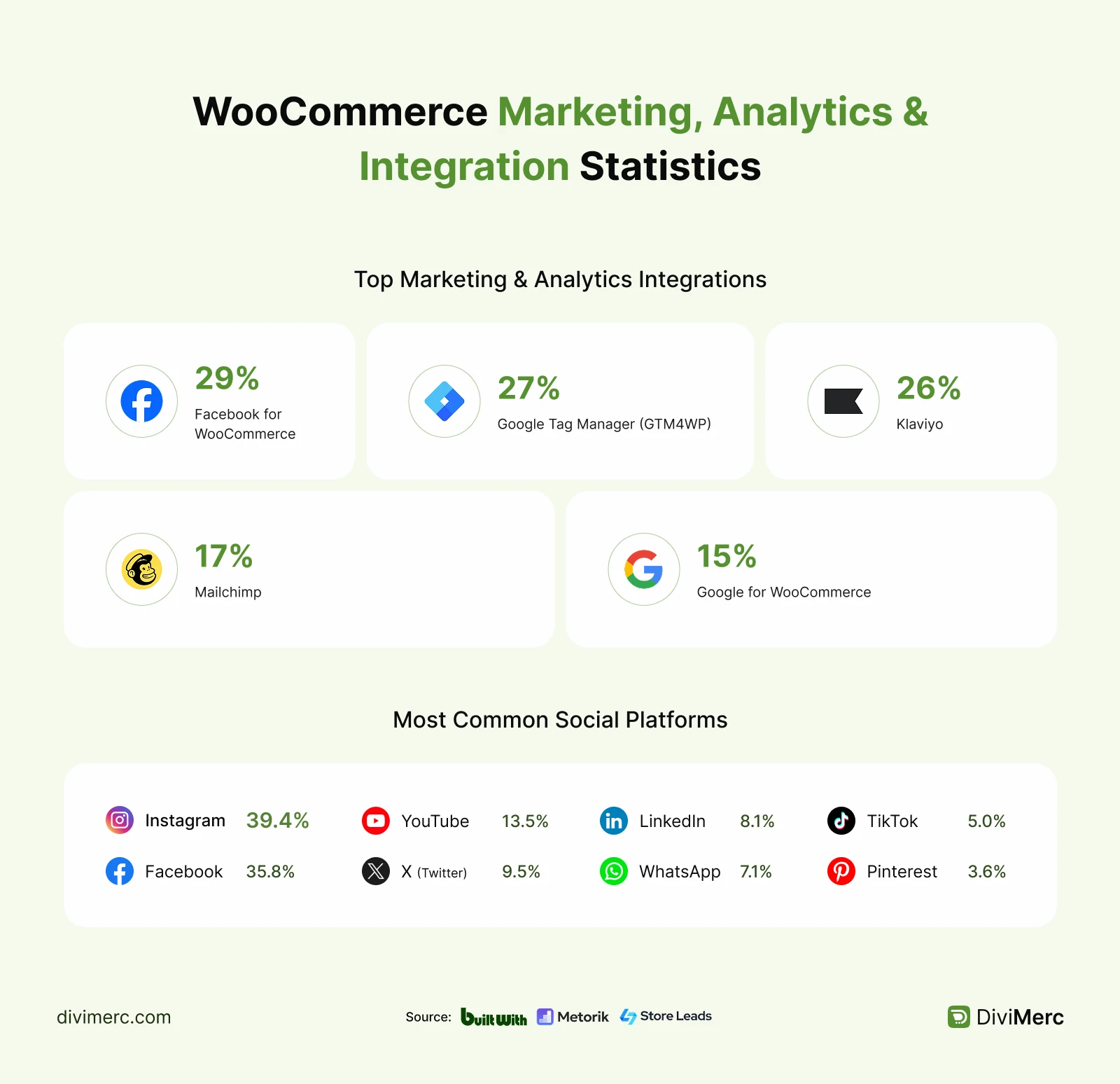
100. 29% of Stores Use Facebook for WooCommerce
The official Facebook integration, used for syncing products and running social commerce, is active on 29% of stores. (Metorik)
101. 26% of Stores Use Klaviyo
Klaviyo remains a leading email marketing integration for WooCommerce stores. (Metorik)
102. 17% of Stores Use Mailchimp
Mailchimp holds a smaller but steady share of the WooCommerce email marketing space. (Metorik)
103. 27% of Stores Use Google Tag Manager (GTM4WP)
More than a quarter of stores use Google Tag Manager to organize their marketing analytics. (Metorik)
104. 15% of Stores Use Google for WooCommerce
This integration syncs a store's product catalog with Google Shopping and other Google services. (Metorik)
105. Over 64,000 WooCommerce Sites Have 10,000+ Social Followers
BuiltWith detects tens of thousands of WooCommerce websites with a genuinely large social media following. (BuiltWith)
106. Instagram Is the Most Common Social Platform for WooCommerce Stores
Among socially active WooCommerce merchants, Instagram leads at 39.4%, followed by Facebook (35.8%), YouTube (13.5%), X (9.5%), LinkedIn (8.1%), WhatsApp (7.1%), TikTok (5.0%), and Pinterest (3.6%). (Store Leads)
WooCommerce Security Statistics
107. Researchers Logged 11,334 New WordPress Ecosystem Vulnerabilities in 2025
That figure covers WordPress core, themes, and plugins across the whole ecosystem WooCommerce runs on. (Patchstack)
108. 12% of Stores Are Running an End-of-Life PHP Version
As noted earlier in our performance section, roughly 1 in 8 WooCommerce stores still runs PHP 7.4, which no longer receives security patches – a real risk with a genuinely simple fix. (Metorik)
WooCommerce Location and Language Statistics
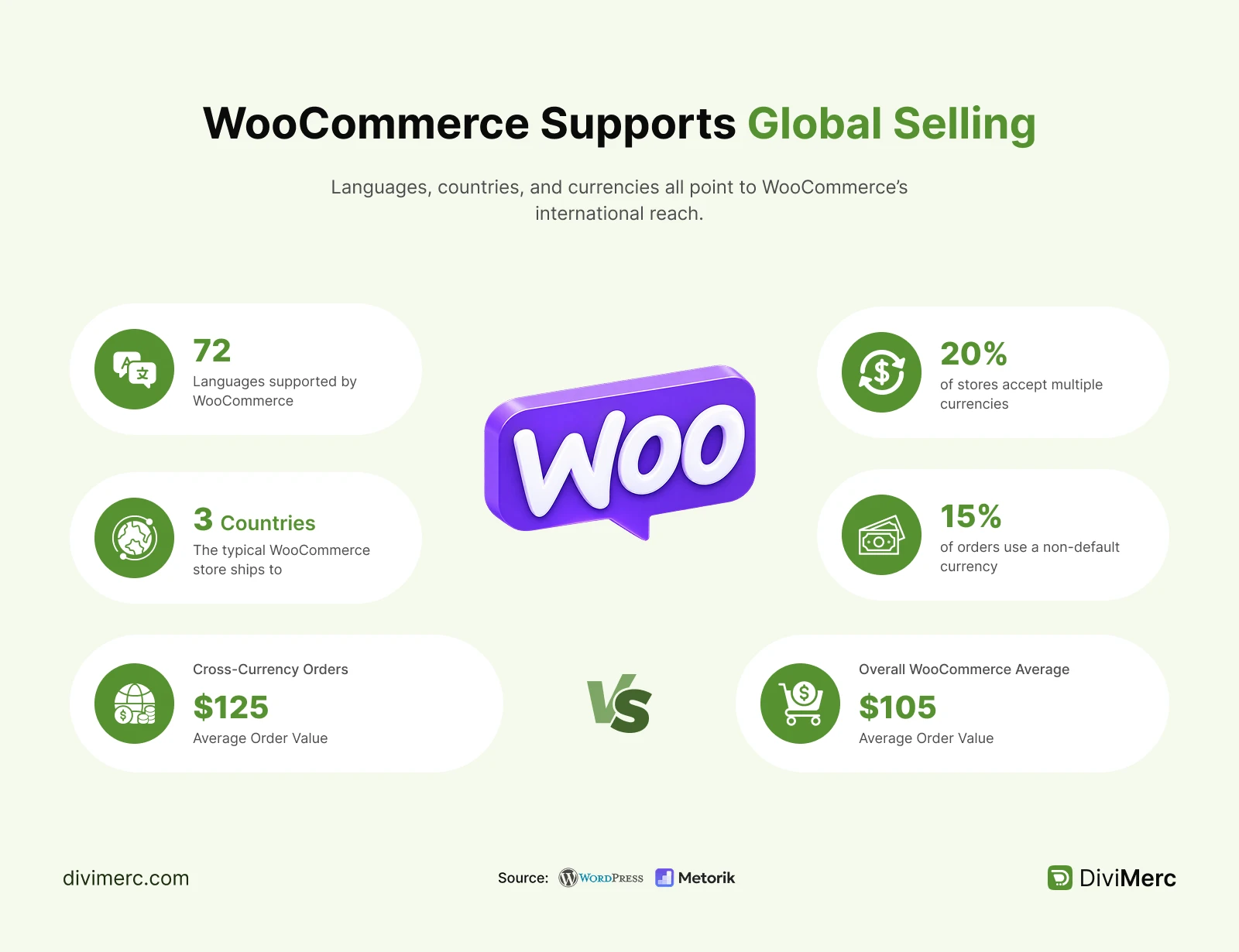
109. WooCommerce Is Available in 72 Languages
WooCommerce supports 72 languages, making it accessible to merchants and shoppers around the world. (WordPress.org)
110. The Typical Store Ships to Three Countries
The average WooCommerce store receives orders from about three different countries. (Metorik)
111. 20% of Stores Accept Multiple Currencies
One in five WooCommerce stores accepts payment in more than one currency. (Metorik)
112. 15% of Orders Use a Non-Default Currency
About 15% of all WooCommerce orders are placed in a currency other than the store's primary one. (Metorik)
113. Cross-Currency Orders Average $125
Orders placed in a non-default currency average $125, notably higher than the platform-wide $105 average. (Metorik)
Frequently Asked Questions About WooCommerce Statistics
How many WooCommerce stores are there in 2026?
It depends on the source. Store Leads counts 4+ million live stores. WordPress.org reports more than 7 million active plugin installations. BuiltWith detects WooCommerce code on over 6.2 million live sites. All three numbers are correct – they're just measuring different things.
What is WooCommerce's market share?
As of August 2026, W3Techs reports, from the sites they can track and identify, WooCommerce lives inside 8.1% of all websites and 48.1% of eCommerce sites.
Is WooCommerce growing or shrinking?
WooCommerce remains the largest eCommerce platform by share, but its overall website share has slipped slightly, from around 9% in mid-2025 to 8.1% in August 2026. That's a maturing market, not a collapse.
Is WooCommerce bigger than Shopify?
By live store count, yes – WooCommerce leads with roughly 4+ million stores versus Shopify's 3+ million. By total sales volume (GMV), Shopify is significantly larger, with an estimated $378 billion processed in 2025.
What percentage of WordPress sites use WooCommerce?
Roughly 19–20% of all WordPress websites have WooCommerce installed and active.
What is the average WooCommerce order value?
$105, based on Metorik's 2026 analysis of more than 65 million real WooCommerce orders.
Is WooCommerce still worth using in 2026?
Yes, for the right kind of store. WooCommerce still offers full ownership of your store, hosting, and data, plus a massive plugin and theme ecosystem. It fits best for store owners who already use WordPress or want deep customization control.
Is WooCommerce free?
The core WooCommerce plugin is free and open source. Hosting, a domain, premium themes, extensions, and payment processing fees are separate costs you'll still need to budget for.
Which country uses WooCommerce the most?
The United States, with 43.4% of all WooCommerce websites – by far the largest single-country market.
What is the most popular WooCommerce payment gateway?
Stripe, used by 40% of WooCommerce stores through the official Stripe Gateway plugin.
What is agentic commerce, and does it affect WooCommerce?
Agentic commerce refers to AI tools that can search, compare, and even purchase products on a shopper's behalf. WooCommerce launched its own AI assistant protocol (MCP) in late 2025 and is a launch partner for Stripe's Agentic Commerce Suite – meaning this isn't a future trend for WooCommerce stores, it's already live.
Can AI tools like ChatGPT actually shop on WooCommerce stores?
Increasingly, yes. WooCommerce's MCP integration lets AI assistants search products and check inventory directly. Full in-chat checkout hasn't taken off as fast as expected, so most AI-assisted purchases still finish on the store's own website – but AI-referred shoppers already convert at a noticeably higher rate once they arrive.
Why do WooCommerce statistics differ so much between sources?
Different research firms measure different things: live stores vs. all installations, top-traffic sites vs. the entire web, active checkouts vs. any detected WooCommerce code. Always check what a statistic is actually counting before comparing it to a number from a different source.
What the WooCommerce Data Shows in 2026
WooCommerce is no longer the fast-growing newcomer it was a decade ago. It's a mature, massive platform – still the biggest eCommerce system on the web by share, still adding real performance upgrades like HPOS, and now moving quickly into AI and agentic commerce alongside the rest of the industry.
The numbers also show a platform that rewards store owners who keep up: stores on the latest WooCommerce version, with HPOS turned on and a current PHP version, are meaningfully faster and safer than stores running years-old setups. And with AI-referred shoppers already spending more per visit than average, how a store's product data looks to an AI agent is quickly becoming as important as how it looks to a human shopper.
The platform itself is stable. What separates a store that's thriving from one that's just getting by increasingly comes down to how well-built, well-maintained, and well-merchandised that individual store actually is.





0 Comments